

T4 2023 – Cultiver le changement grâce à l’agriculture régénérative
Sustainability has become an increasingly prominent theme in many industries, and the same is true of agriculture. Agriculture and agrifood system sustainability has drawn attention from both sector participants as well as policymakers and other stakeholders. As a notable and recent example, a full day of 2023’s UN Climate Change Conference COP28 conference in Dubai was dedicated specifically to food and agriculture, representing a landmark first for any COP.(1)
When we consider where and how the world’s food will be grown for future generations, there is a clear impetus to ensure a sustainable global food system that will provide continuity of supply for a growing global population, while preserving – and improving – the land resources that are required to produce food. Initially coined in the early 1980s by U.S.-based organic research center the RodaleI nstitute, the term “regenerative agriculture” has been in the spotlight in the media, politics, academia, and the global business community in recent years.(2) This might bring a few questions to our readers’ minds:
- How is “regenerative agriculture” defined?
- Pourquoi est-ce pertinent ?
- Quels sont les défis et opportunités associés ?
- Où se situe le Canada par rapport à ses pairs mondiaux ?
Définir l’agriculture régénérative
Despite recent widespread use of the phrase, there is no singular, universally accepted legal or regulatory definition for “regenerative agriculture”.(3) This sets the idea of regenerative agriculture apart from a conceptually similar, but distinct phrase “organic”, and the related descriptive prefixes “bio-” and “eco-“, which are legally defined and protected in Europe, amongst other jurisdictions.(4)
Instead, the term “regenerative” is used to refer to various practices (e.g., the use of cover crops, or reducing or eliminating soil tillage), desired outcomes (e.g., better soil quality, or more biodiversity), or some combination of the two.(3) Malgré l'absence de consensus sur ce qu'implique exactement l'agriculture régénérative, il existe un certain consensus sur le fait que les principaux principes et objectifs de l'agriculture régénérative sont de promouvoir une vision holistique du système alimentaire mondial afin d'améliorer la santé des sols, l'environnement dans son ensemble, la santé humaine et Prospérité économique.(4)
De même, McCain Foods – un leader canadien de l’industrie alimentaire mondiale qui produit une frite sur quatre consommée dans le monde.(5) – définit de manière concise l’agriculture régénérative comme :
“… an ecosystem-based approach to farming that aims to improve farmer resilience, yield, and quality by improving soil health, enhancing biodiversity, and reducing the impact of synthetic inputs.”(6)
Outlined in McCain Foods’ Regenerative Agriculture Framework is a set of six principles that can be applied to growing potatoes. Many of those principles can also be applied in the context of growing crops such as wheat, corn, soy, peas, or higher-value fruits and vegetables:
Principes d'agriculture régénérative de McCain Foods(7)
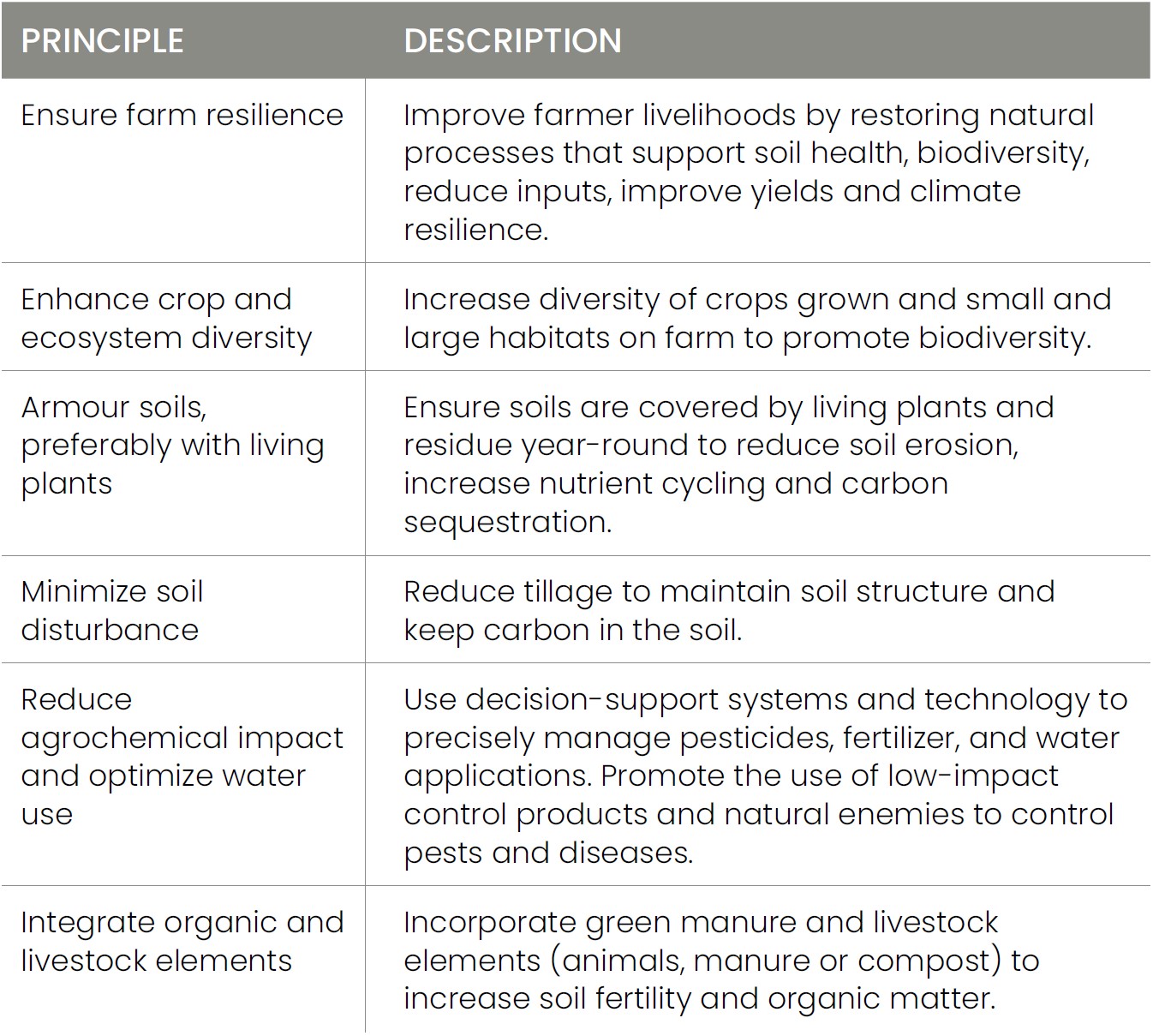
At a glance, some of these principles may seem different than what many would think are incorporated into conventional farming practices. However, based on Bonnefield’s decade-plus experience managing portfolios of high-quality Canadian farmland properties, we have observed that many Canadian crop farmers have employed practices that align with these concepts for years, and often seek opportunities to further improve. Anecdotally, Canadian farm operators acknowledge that sustainable practices can enhance yields and crop quality, while also enhancing and supporting farmland values and long-term production.
Pourquoi l’agriculture régénérative est-elle importante ?
La production alimentaire mondiale a dû considérablement augmenter pour soutenir une croissance démographique rapide. Dans la seconde moitié du XXe siècle, les rendements agricoles ont augmenté à un rythme sans précédent ; les rendements céréaliers ont augmenté de 2 071 TP3T au cours des cinq décennies entre 1961 et 2021, tandis que la superficie totale utilisée pour la production céréalière n’a augmenté que de 141 TP3T.(8)
This agricultural intensification – or increased crop production on a relatively similar amount of land – has largely been achieved through the strategic use of chemicals (e.g., fertilizer, pesticides, fungicides, and herbicides), crop irrigation, mechanization and technology (e.g., improved and more-efficient farm machinery, precision agriculture technology), and improved seed genetics that have improved seed genetics that has strengthened plant resilience plants’ resilience to disease, drought, and other material risks.(8)
La population mondiale devrait atteindre 8,5 milliards d’ici 2030 et croître encore pour atteindre 9,7 milliards en 2050.(9), meaning that the world’s demand for food will continue to increase. However, this growth also means that land that is currently uninhabited or used for other purposes – like farming – will face additional pressure (and, likely, decline) as cities expand to accommodate more people.
Il faut trouver un équilibre délicat entre le besoin d’une alimentation suffisante et nutritive et le besoin de logement, tant au Canada que partout dans le monde. D’un point de vue agricole, cela souligne la nécessité d’employer des pratiques pour augmenter la production, tout en soutenant la durabilité de cette ressource limitée au cours des prochaines décennies.
Opportunités & Défis
Alors que nous envisageons la demande future de production agricole dans un monde où les terres arables diminuent, l’idée selon laquelle les pratiques agricoles devraient évoluer pour intégrer des pratiques de plus en plus durables peut sembler intimidante mais nécessaire. D’une part, il faudra peut-être plusieurs années aux agriculteurs qui s’appuient actuellement sur des pratiques agricoles moins durables telles que la monoculture durable (c’est-à-dire planter le même type de culture pendant plusieurs années consécutives) pour réussir la transition vers des pratiques plus régénératrices. Cette période de transition nécessite un investissement en capital, en intrants et en temps qui aura un impact sur la production agricole pendant au moins une à deux saisons de croissance.(10) Cependant, ceux qui ont une vision multigénérationnelle de l’agriculture reconnaissent que sans pratiques durables, la faisabilité à long terme des opérations agricoles sera affectée négativement.
Outre les coûts de transition, certains se demandent si les pratiques agricoles régénératrices permettront aux agriculteurs de maintenir les niveaux de production actuels. Une étude de terrain menée sur trois décennies par le Rodale Institute a révélé qu'après la période de transition initiale, il y a généralement peu ou pas de différence entre les rendements des cultures dans les fermes conventionnelles et dans les fermes régénératives.(10) En outre, l’étude a révélé que les champs régénératifs étudiés surpassaient leurs homologues cultivés de manière conventionnelle dans des conditions stressantes, en particulier lors des sécheresses, car les champs régénératifs étaient mieux capables de retenir l’eau.(10) Au-delà de l’absence d’impact à long terme sur les rendements des cultures et du fait que les pratiques régénératrices contribuent également positivement aux initiatives mondiales sur le changement climatique, les avantages potentiels comprennent :
- Coûts réduits au fil du temps résultant d’une diminution du besoin en intrants bruts
- Amélioration de la qualité du sol, de la rétention d'humidité et de l'équilibre des éléments nutritifs, ce qui peut favoriser de solides rendements et des cultures de haute qualité.
- Augmentation de la disponibilité de l’eau à la ferme pour une utilisation sans irrigation, ou réduction globale des besoins en eau
- Accès potentiel à une aide financière via des subventions ou d’autres programmes non gouvernementaux
Quelle est la position du Canada?
Alors que les consommateurs et autres parties prenantes ont commencé à exiger une durabilité et une responsabilité accrues tout au long de la chaîne de valeur agroalimentaire, les transformateurs à valeur ajoutée ont démontré un réel désir de travailler avec des agriculteurs soucieux de la durabilité.
Les grands transformateurs se positionnent déjà pour répondre à la demande croissante de produits agroalimentaires issus de sources durables. À titre d'exemple récent, McCain a pris un engagement ambitieux à s'approvisionner en 1001 TP3T de ses pommes de terre auprès de fermes régénératives d'ici la fin de 2030.(7) While definitions of regenerative farming may differ between enterprises, we believe that this approach is broadly reflective of the industry’s overall tone and direction looking ahead. This means that for Canadian farmers to remain competitive, they will likely need to incorporate (or continue to utilize) regenerative farming practices in their operations.
The importance of innovation and the role of regenerative farming practices in ensuring the sustainability of Canada’s agriculture industry is not new to farmers. The most recent Census of Agriculture found that while the area of farms across the country declined by approximately 3% between 2016 and 2021, many Canadian farmers implemented precision technologies designed specifically to enhance efficiency and yields, and nearly 65% of operators reported that they engaged in sustainable farming practices.(11) This data points to farmers’ understanding that leveraging these advancements is crucial and, while the field of regenerative agriculture will keep evolving, we believe that Canadian farm operators will continue to demonstrate the adaptability and resilience for which they have become known.
Un partenaire solidaire pour un avenir durable
Recognition of Canadian agriculture’s role in the context of global food security, water scarcity, and climate change has underpinned Bonnefield’s business model since the firm’s founding over a decade ago. This includes playing a role as a supportive, non-controlling, partner to progressive Canadian farmers and agribusiness operators as they consider how best to grow for the future.
As one example of our inherent support for agricultural sustainability practices, Bonnefield’s Standards of Care – a set of agronomic best practices developed in conjunction with industry experts to preserve and enhance farmland through sound land management principles – are an integral part of each of Bonnefield’s farmland lease contracts. This hallmark component of our farmland sale-leaseback model includes parameters that are designed to protect and enhance soil health, ensure responsible resource usage, and to generally promote good land stewardship. At a high level, the Standards of Care align to some of the core principles of regenerative agriculture, with a view to both ensuring the long-term productivity of the farms owned by our funds and their long-term value.
Beyond the Standards of Care, Bonnefield actively contributes to the enhancement of Canada’s agricultural industry and long-term sustainability. We have been active participants in the ongoing development of Canada’s National Index on Agri-Food Performance and in August 2023, Bonnefield joined Farm Credit Canada, Manulife Investment Management, and McCain Foods to launch the Canadian pilot of Leading Harvest – a third-party audited Farmland Management Standard designed to promote sustainable agricultural practices.
It is clear that weaving sustainable principles into the fabric of the industry will be an essential part of Canadian agriculture’s growth story, particularly as it becomes more essential than ever in a global context. As a trusted partner to farmers and agribusiness operators, Bonnefield will continue to support progressive farmers and value chain participants as we build a brighter, and sustainable, future for Canadian agriculture.
À propos de Bonnefield Financière
Bonnefield is a leading Canadian farmland and agriculture investment manager, providing financing to progressive farmers and agricultural operators through land-lease and non-controlling equity solutions. Bonnefield is dedicated to preserving farmland for farming, and the firm partners with growth-oriented operators to help them grow, reduce debt, and finance retirement and succession. The firm’s investors are individuals and institutional investors who are committed to the long-term future of Canadian agriculture. www.bonnefield.com
This document is for information purposes only and does not constitute an offer or solicitation to buy or sell any securities in any jurisdiction in which an offer or solicitation is not authorized. Any such offer is made only pursuant to relevant offering documents and subscription agreements. Bonnefield funds (the “Funds”) are currently only open to investors who meet certain eligibility requirements. The Funds will not be approved or disapproved by any securities regulatory authority. Prospective investors should rely solely on the Funds’ offering documents which outline the risk factors in making a decision to invest. No representations or warranties of any kind are intended or should be inferred with respect to the economic return or the tax consequences from an investment in the Funds. The Funds are intended for sophisticated investors who can accept the risks associated with such an investment including a substantial or complete loss of their investment.
Sources:
1. Douglas, L. (2023). Rots de vaches et gaspillage alimentaire à l'honneur lors de la Journée de l'agriculture. Actualités Reuters. 2. Giller, K. et coll. (2021). Agriculture régénérative : une perspective agronomique. Perspectives de l'agriculture, vol. 50 numéro 1 – mars 2021. 3. Newton, P. et coll. (2020). Qu’est-ce que l’agriculture régénérative ? Un examen des définitions des chercheurs et des praticiens basées sur les processus et les résultats. Frontières des systèmes alimentaires durables, volume 4. 4. Lunik, E. et al. (2023). Regenerative Agriculture’s Many Shades of Green: A Review of Current Status and Potential Progress. RaboResearch. 5. Aliments McCain. Notre activité et nos marques. 6. Aliments McCain. Agriculture régénératrice chez McCain Foods. 7. Aliments McCain. McCain’s Regenerative Agriculture Framework. 8. Ritchie, H. (2017, rév. 2022). Rendement versus utilisation des terres : comment la révolution verte nous a permis de nourrir une population croissante. Notre monde dans les données. 9. Les Nations Unies. Enjeux mondiaux : population. 10. EIT Food Sud. (2020). L’agriculture régénérative peut-elle remplacer l’agriculture conventionnelle ?. Institut européen d'innovation et de technologie (un organisme de l'Union européenne). 11. Statistique Canada (2022). Canada’s 2021 Census of Agriculture: A Story About the Transformation of the Agriculture Industry and Adaptiveness of Canadian Farmers.