

T1 2024 – Opportunité d’investissement dans l’agro-industrie canadienne
Sophisticated investors are increasingly looking at Canada’s agricultural industry for attractive, diversified opportunities. In the global context, Canada’s agriculture and agri-food industry punches well above its weight. Despite ranking as the 12th largest OECD nation by population, Canada is the world’s fifth largest agricultural exporter and the fourth largest exporter amongst OECD countries.(1) Nous prenons au sérieux notre rôle dans l’alimentation durable du monde, en opérant dans un cadre réglementaire solide qui respecte les meilleures pratiques de gouvernance et d’exploitation de sa catégorie. Cependant, malgré cette dynamique, les producteurs et les transformateurs canadiens souffrent d'un sous-investissement chronique en raison d'un manque d'accès au capital, ce qui freine la croissance et entraîne des inefficacités à l'échelle de l'industrie, ce qui crée un environnement attrayant pour l'investissement.
There has been a lot of recent discussion about Canada’s anemic rate of capital investment. According to OECD data, between 2011 to 2015, the rate of investment in Canada was among the bottom third of member nations, placing 37 out of 47. The situation worsened from 2015 to 2023, in which Canada dropped to 44 out of 47 nations. This trend impacts all industries, including agriculture, where Bonnefield has witnessed the pressing need for capital firsthand. For the last 15 years, Bonnefield has forged strong, trusting relationships with Canadian farmers, providing them with alternative financing solutions to enable their continued growth. Through these relationships, Bonnefield has seen the need for capital investment beyond farmland, across the entire agricultural value chain. We recently launched a fund to address this need by providing noncontrolling growth capital to a broader range of agribusiness in Canada. 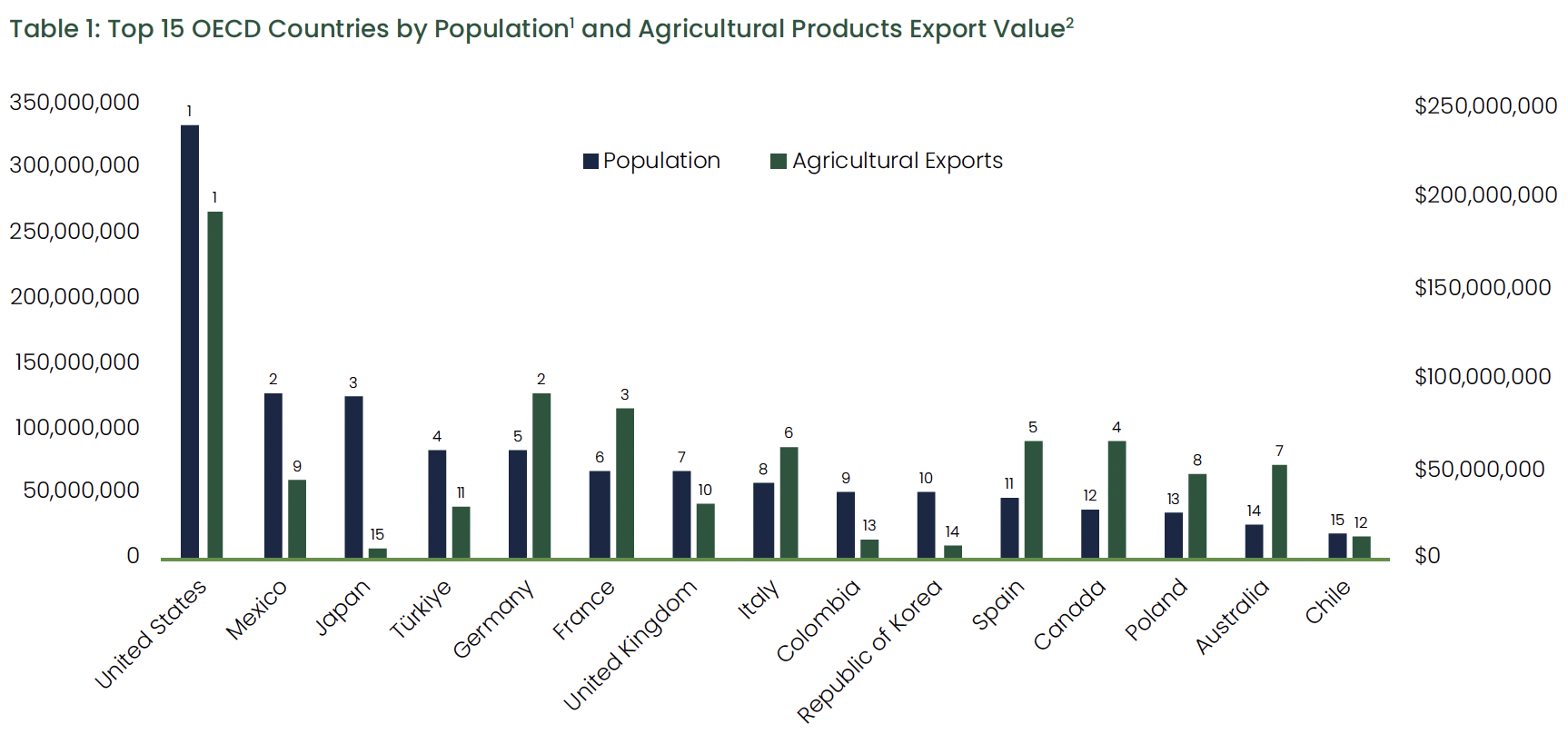
Taille de l'opportunité
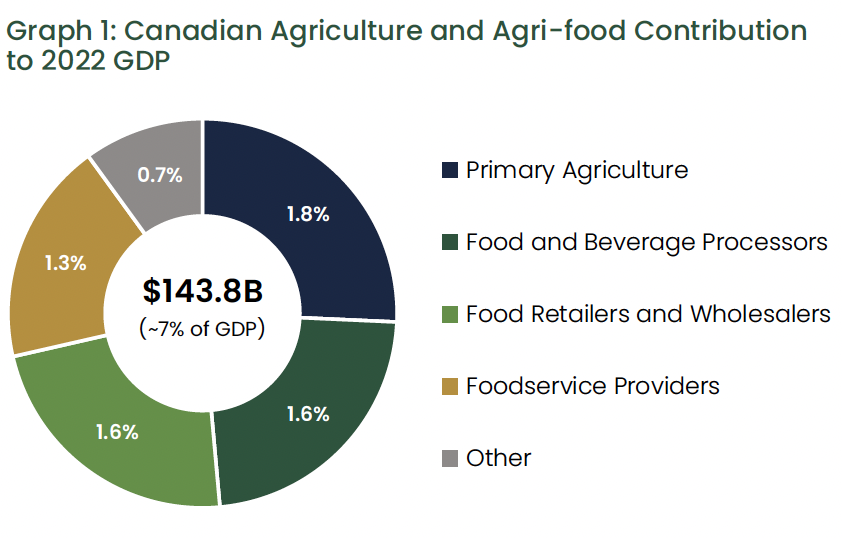
Les industries agricoles et agroalimentaires comptent parmi les secteurs les plus importants de l'économie canadienne, représentant environ 7% du PIB et employant 2,3 millions de personnes en 2022.(3) Il existe à elle seule plus de 8 500 entreprises canadiennes de transformation des aliments et des boissons.(4), many of which are continuing to expand both domestically and internationally to meet growing demands. Today approximately half of everything that Canadian agriculture and agri-food produces is exported as either primary commodities or processed food and beverage products.(5) La demande croissante de produits alimentaires, stimulée par la croissance démographique, souligne le potentiel d’investissement dans les agro-entreprises canadiennes. La population mondiale devrait atteindre près de 10 milliards d’habitants d’ici 2050, ce qui nécessitera une augmentation substantielle de la production alimentaire pour répondre à la demande croissante, les projections actuelles prévoyant une augmentation de la demande alimentaire mondiale de 35% à 56% entre 2010 et 2050.(6) Répondre à cette demande accrue sera particulièrement difficile face aux défis climatiques et à la baisse des rendements agricoles, deux facteurs qui constituent des avantages concurrentiels pour le Canada. Grâce à notre vaste expertise en matière de production et de secteur agricole, il est possible de débloquer une croissance démesurée au Canada et de renforcer notre position en tant que partenaire commercial agricole de confiance et reconnu à l’échelle mondiale.
Aujourd’hui, environ la moitié de tout ce que produit le secteur agricole et agroalimentaire canadien est exporté soit sous forme de produits primaires, soit sous forme de produits alimentaires et de boissons transformés5. La demande croissante de produits alimentaires, stimulée par la croissance démographique, souligne le potentiel d’investissement dans les entreprises agroalimentaires canadiennes. La population mondiale devrait atteindre près de 10 milliards d’habitants d’ici 2050, ce qui nécessitera une augmentation substantielle de la production alimentaire pour répondre à la demande croissante, les projections actuelles prévoyant une augmentation de la demande alimentaire mondiale de 35% à 56% entre 2010 et 2050.6 Il sera particulièrement difficile de répondre à cette demande accrue. un défi face aux défis climatiques et à la baisse des rendements agricoles, deux facteurs qui constituent des avantages concurrentiels pour le Canada. Grâce à notre vaste expertise en matière de production et de secteur agricole, il est possible de débloquer une croissance démesurée au Canada et de renforcer notre position en tant que partenaire commercial agricole de confiance et reconnu à l’échelle mondiale.
Comment (et où) investir
In 2017, the Canadian federal government’s Advisory Council on Economic Growth released a set of recommendations to improve Canada’s economic growth trajectory. This report, which is commonly referred to as “the Barton Report”, identified agriculture and agri-food as one of the key sectors with potential to drive substantial economic growth and increase exports. Since that time, however, we have seen limited investment in the sector relative to demand from producers and the opportunity for attractive returns. Increasing exports is critical to the future success of Canadian agriculture and agri-food and requires investment to enable expansion of operations and enhancement to storage, transportation, processing, and manufacturing capabilities. This investment will allow Canadian operators to capture a greater share of the value created in the broader value chain. To date, underinvestment has posed challenges for the sector’s ability to grow and meet expanding demand. Investment in the food processing industry as a percentage of revenue decreased by ~50% from 1998 to 2016.(7)Comme le montre le graphique ci-dessous, l'investissement annuel en capital dans les équipements et machines agricoles a été en retard sur la dépréciation (c'est-à-dire l'investissement requis uniquement pour remplacer l'équipement vieillissant) au cours des 15 dernières années d'un montant cumulé de $12,9 milliards.(8).
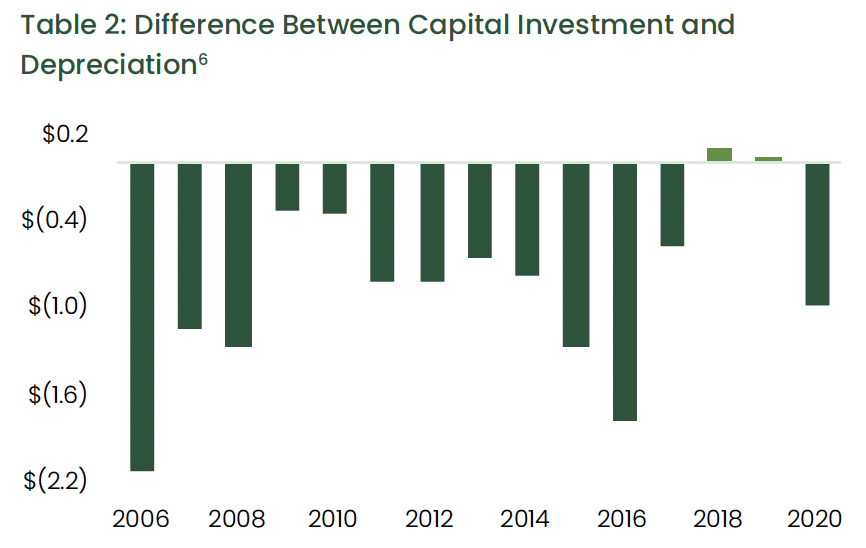
These challenges for Canadian agribusinesses present an opportunity for investors to fill the investment gap and drive growth in the sector. Investing in modernizing agricultural infrastructure, and investments in value-added processing facilities can unlock new opportunities for growth and innovation, and enable producers to tap into growing export demand. By investing in Canadian agribusinesses, investors can not only generate attractive returns but also contribute to the growth, sustainability, and competitiveness of Canada’s agriculture and agri-food sectors, ensuring a prosperous future for Canadian agriculture.
Le Fonds agroalimentaire Bonnefield
With nearly 15 years’ experience supporting Canadian farmers with land-based financing solutions, the team at Bonnefield has seen significant opportunities to support the growth and capital needs of leading agribusiness operators across the value-chain. For this reason, we launched the Bonnefield Agribusiness Fund LP I (“Agribusiness Fund”) in 2023, to invest in established, lower-middlemarket agribusinesses with significant growth opportunities. 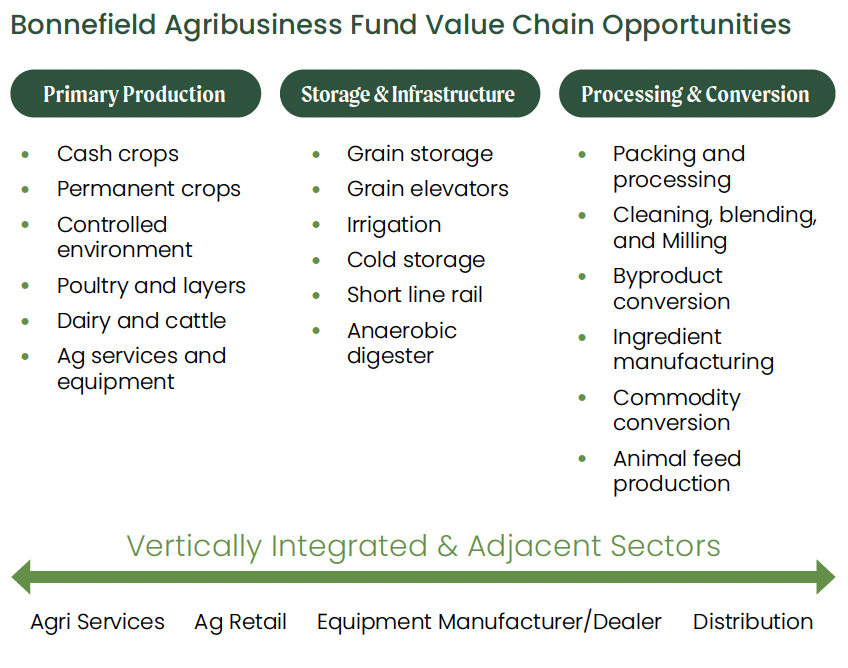
Bonnefield’s Agribusiness Fund invests non-controlling capital through structured solutions, including subordinated debt, preferred equity, and/or equity with warrants, as well as facilitating sale-leaseback arrangements on vital agricultural infrastructure. Bonnefield’s approach is to be a customizable capital solution for business owners across the agricultural value chain. We use structured capital to minimize downside risk to investors, while participating in some of the upside from equity value creation. Bonnefield has deep industry roots and expertise in Canadian agriculture, with long-established agricultural operating partners. This experience provides unparalleled access to investment opportunities with agri-business owners who see Bonnefield as a value-add partner that brings more than just capital – our robust network of farm operators and industry experts that we can leverage to support their growth. 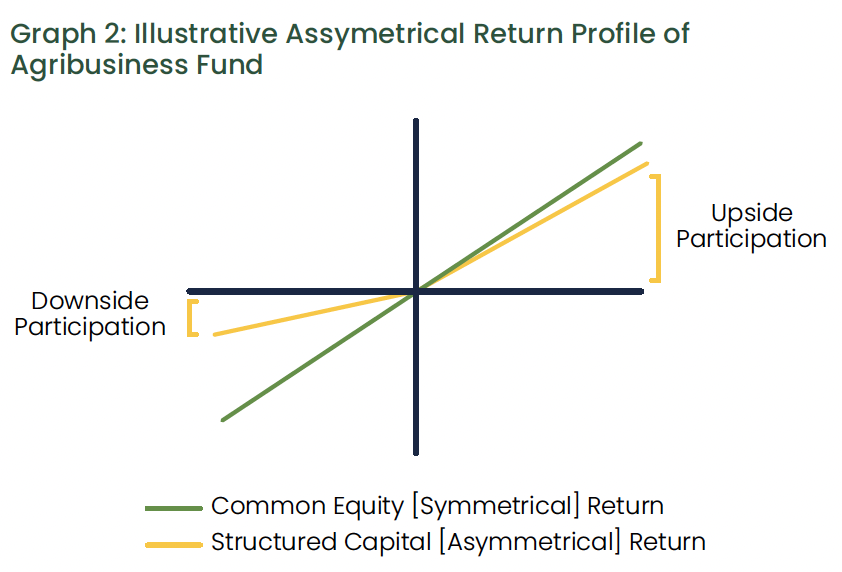
We see an attractive opportunity to invest in leading Canadian agribusinesses while providing attractive risk-adjusted returns to our investors. We are excited to be able to support the long-term growth and expansion of Canada’s agriculture and agri-food global footprint. The launch of Bonnefield’s Agribusiness Fund reaffirms our dedication to advancing the future of Canadian agriculture.
Pour plus d'informations sur le Fonds Agribusiness Bonnefield, veuillez contacter investors@bonnefield.com
À propos de Bonnefield Financière
Bonnefield is a leading Canadian natural capital investment manager that invests in farmland and agribusinesses. We provide capital to progressive farmers and agribusiness operators through land-lease financing and non-controlling equity solutions. Bonnefield is dedicated to preserving farmland for farming and promoting sustainable production practices. The firm partners with growth-oriented farmers and agribusiness operators to help them grow, reduce debt, and finance retirement and succession. The firm’s investors are individuals and institutional investors who are committed to the long-term future of Canadian agriculture. www.bonnefield.com
Sources
1. La Banque mondiale. Division de la population des Nations Unies. Perspectives de la population mondiale : révision 2022.
2. Organisation des Nations Unies pour l'alimentation et l'agriculture. Division des statistiques de la FAO – Total des produits agricoles, à l'exclusion des produits de la pêche et de la foresterie.
3. Gouvernement du Canada. Aperçu du système agroalimentaire canadien.
4. Gouvernement du Canada. Aperçu de l'industrie de la transformation des aliments et des boissons.
5. Alliance canadienne du commerce agroalimentaire. Exportations agroalimentaires.
6. van Dijk, M., Morley, T., Rau, ML et al. Une méta-analyse de la demande alimentaire mondiale projetée et de la population exposée au risque de faim pour la période 2010-2050. Nat Food 2, 494-501 (2021).
7. Statistique Canada. Tableau 34-10-0278-01 Publications historiques (en temps réel) des dépenses en immobilisations et réparations, immobilisations corporelles non résidentielles, par industrie et géographie (x 1 000 000).
8. Statistics Canada. Table 34-10-0036-01 “Capital and repair expenditures, non-residential tangible assets by industry (x 1,000,000)”; Table 32-10-0049-01 “Farm Operating Expenses and Depreciation Charges (x 1,000).
This document is for information purposes only and does not constitute an offer or solicitation to buy or sell any securities in any jurisdiction in which an offer or solicitation is not authorized. Any such offer is made only pursuant to relevant offering documents and subscription agreements. Bonnefield funds (the “Funds”) are currently only open to investors who meet certain eligibility requirements. The Funds will not be approved or disapproved by any securities regulatory authority. Prospective investors should rely solely on the Funds’ offering documents which outline the risk factors in making a decision to invest. No representations or warranties of any kind are intended or should be inferred with respect to the economic return or the tax consequences from an investment in the Funds. The Funds are intended for sophisticated investors who can accept the risks associated with such an investment including a substantial or complete loss of their investment.